

Blog
How to Read CT Rotations on Nuke Without Getting Chewed Up

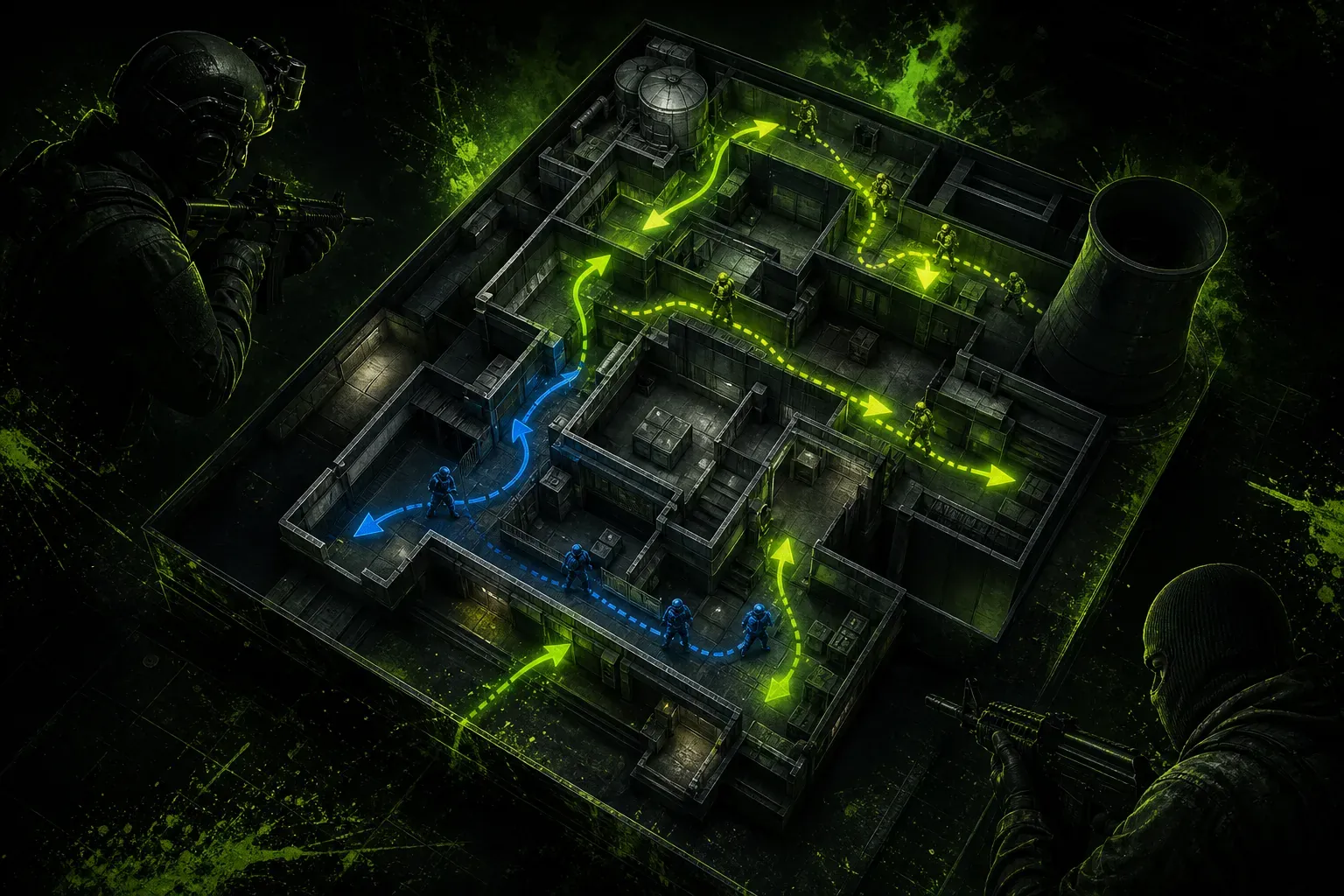
You’re on Nuke, the round’s already ugly, and your anchor in Hut just got forced off by a lobby crunch. Now the whole server is staring at you like you’re supposed to magically know whether that CT rotator is coming Heaven, Ramp, or Secret. That’s the real Nuke test. Not aim. Not “good comms.” Reading rotations before they hit you in the teeth.
Nuke punishes lazy radar watching harder than almost any map in CS2. Because of the vertical layout, one bad call can turn into a full collapse in about three seconds flat. One player leaves A early, outside cracks open, and suddenly you’re guessing whether the CT is rotating down through Mini or wrapping through Lobby to trap your late push. If you’re guessing, you’re already late.
Why Nuke makes rotation reads feel unfair
Nuke is one of those maps where CT movement isn’t just movement — it’s information. You’ve got Hut, Squeaky, Ramp, Main, Secret, Ladder Room, Heaven, Vents, and every single one of those spaces creates a different sound cue, timing, and gap in coverage. That’s why teams still love this map at pro level. The best teams don’t “hold” Nuke, they play it like a shifting net.
On Source 2, subtick made peeks and utility feel cleaner, but it didn’t change the core truth of Nuke: rotations are still about timing windows. If the CTs are rotating too early, the T side gets free space. If they’re late, you get boxed in by crossfires that feel disgusting to play against. This is the same reason teams like Vitality and NAVI look so sharp here when players like ZywOo or s1mple are dragging attention all over the place. The map rewards whoever can make the other side react first.
The biggest mistake: staring at the wrong clue
A lot of players try to read rotations by watching the minimap like it’s a stock ticker. Bad idea. You want to pair info, not worship it. One radar ping means almost nothing by itself. A smoke, a flash response, a footstep, and a timing gap together? That’s a real read.
Think about it like this:
- If your Outside lurker hears a Ramp molly at 1:15, the CTs probably want to stall for a top-side retake setup.
- If Lobby gets abandoned after a noisy flash, someone’s likely rotating to cover Mini or Hut.
- If you hear a CT step in Vents while your team still has Lobby control, they’re probably trying to cut off a split before it starts.
- If the Heaven player disappears after one and done contact, don’t assume they’re gone — they’re probably just changing levels.
The point is simple: don’t read one cue. Read the pattern. That’s what separates a 14k CS Rating player from someone bouncing between 7k and 10k because they keep walking into the same setup.
Where CTs actually go, and what that means for you
CT rotations on Nuke usually fall into a few ugly, predictable routes. Once you know the common paths, the whole map starts making sense. And no, “just hit the opposite site” isn’t a read — that’s what bronze players say after losing a 4v2.
Hut and Heaven pressure changes everything
If the CT on A gets pressured out of Hut, the team often shifts someone to Heaven or Mini to stabilize the upper site. That leaves a tiny timing window where Lobby control becomes terrifying for the CT side. If you’re a T, that’s when you need to be ready to explode through Squeaky or punish the guy trying to re-clear Hut with his knife still out.
Heaven rotators are the most dangerous ones because they can influence both sites. A CT dropping from Heaven to Ramp, or floating from Heaven toward Mini, can fake a full commitment while still staying close enough to punish noise. You’ll see this all the time in high-level matches when teams are playing for a late-round retake. It’s the same kind of patience you see from players like m0NESY — not over-rotating, just holding the map hostage until the T side shows its hand.
Ramp rotations are slower than people think
Ramp is weird. It feels active because there’s always utility flying around, but CTs don’t actually leave Ramp instantly unless they’ve got a strong reason. A Ramp player usually wants to stay in contact until they’re either forced out or the outside hit is clearly the real play. If you stop hearing Ramp noise and the CT utility shifts elsewhere, that’s your cue that someone may have rotated through Vents or down to B support.
That’s the read: not “they’re gone,” but “they’re trying to hold two places with one body.” That’s when T side should punish with a fast mid-round split, not drift into a molly-soaked choke point like they’re queueing for a highlight reel.
Sound, timing, and the little tells people ignore
Good rotation reads on Nuke come from tiny stuff. Not flashy stuff. Tiny. A door swing. A delayed grenade. A CT who stops jiggle-peeking because he’s waiting for backup. That’s what you should be listening for.
CS2’s audio has been good enough for this for a while now, and because rounds are still won and lost on timing, the difference between hearing a step at 0:38 and 0:35 matters. Three seconds on Nuke is an eternity. That’s enough time for a CT to go from Secret support to Heaven, or for a T lurker to catch someone rotating through Lobby with their crosshair pointed at the wrong ramp.
If you want a practical way to think about it, use this checklist mid-round:
- Who just used utility?
- Did the CTs answer immediately, or was there a delay?
- Did someone make noise while moving between floors?
- Which angle just got abandoned?
If two or more of those line up, the rotation is probably real. If only one lines up, you’re probably chasing ghosts. Nuke loves punishing overreaction.
How to bait the rotation without throwing the round
People love saying “fake the hit” like that’s enough. It isn’t. A fake on Nuke has to create a believable problem. CTs aren’t dumb; they rotate when they think they’re about to lose map control, not because you threw one random flash and yelled “A!” in Discord.
The cleanest fakes usually involve showing enough presence to force utility, then going quiet. If you’re outside, make the CT spend a smoke, maybe a molly, then hold. If you’re Ramp, force the anchor to give up space or burn time. If you’re in Lobby, use the threat of Hut and Squeaky to pin someone in place while your lurker listens for the rotation.
What you’re trying to do is create a bad CT decision. Make them move early, then punish the gap they leave behind. That’s why Nuke rewards patient teams in the Major. Watch any serious playoff series — the good teams don’t sprint from site to site. They drag CTs around first, then hit where the cover gets thin. That’s been true since the old Astralis days and it’s still true now, even with the subtick era smoothing out some of the movement weirdness from the early CS2 patches.
Solo queue Nuke is chaos, so simplify your read
If you’re not in a five-stack, don’t try to play perfect theory CS. You’ll just get mad. In Premier, half the time you’re on a team that has one guy top-fragging, two people muted, and somebody buying a Scout on a save round because they “feel it.” So keep the reads simple.
When you’re T side:
- Take one area cleanly.
- Listen for the CT response.
- Assume the first rotation is defensive, not final.
- Only commit when you know which site lost support.
That last part matters. A lot. If you swing into A because you heard a step in Heaven, you might just be walking into a layered retake with Ramp, Mini, and Heaven all staring at you. That’s not a read. That’s donating a round.
Economy matters here too. If the CTs are on a half buy — say, one rifle, one FAMAS, a couple of pistols, and maybe a defuse kit or two — their rotations tend to be slower and more desperate. They’ll keep a body near the stronger side longer because they can’t afford to fully collapse. That’s your opening. Don’t give them time to rebuild the map.
The read that wins rounds isn’t fancy
The best Nuke players aren’t psychic. They’re just better at spotting the moment the CT side stretches too thin. That’s it. One guy over-rotates to A, one player gets pinned outside, and now the site behind them is exposed like a bad lobby peek.
If you want to stop getting chewed up, stop treating rotations like a mystery and start treating them like a budget. Every CT move costs time, space, or both. Once you see that tradeoff, Nuke stops feeling random.
So next time you’re outside with 40 seconds left and everyone on your team wants to hit the first site they see, ask yourself: which CT just spent their last safe rotation — and who’s about to be too late to save them?